
We built a proprietary data engine that can parse thousands of documents per query, orchestrate millions of LLM calls, and generate structured, decision-ready insights. But one question remained: how do we make that power accessible to everyone?
Our users are domain experts. They know exactly what information they need from their documents, but introducing new technology into those workflows can still create friction.
Many enterprise data platforms require hours spent digging through dense documentation, sitting through webinars you’re politely pretending to watch, or completing certifications that have quietly sat on your career development plan for the last three years.
We didn’t want Parsewise to feel like that.
Instead, we wanted a system that helps users immediately see what’s possible. One that meets them where they are and unlocks the value of the platform from day one.
This is where Navi comes in.
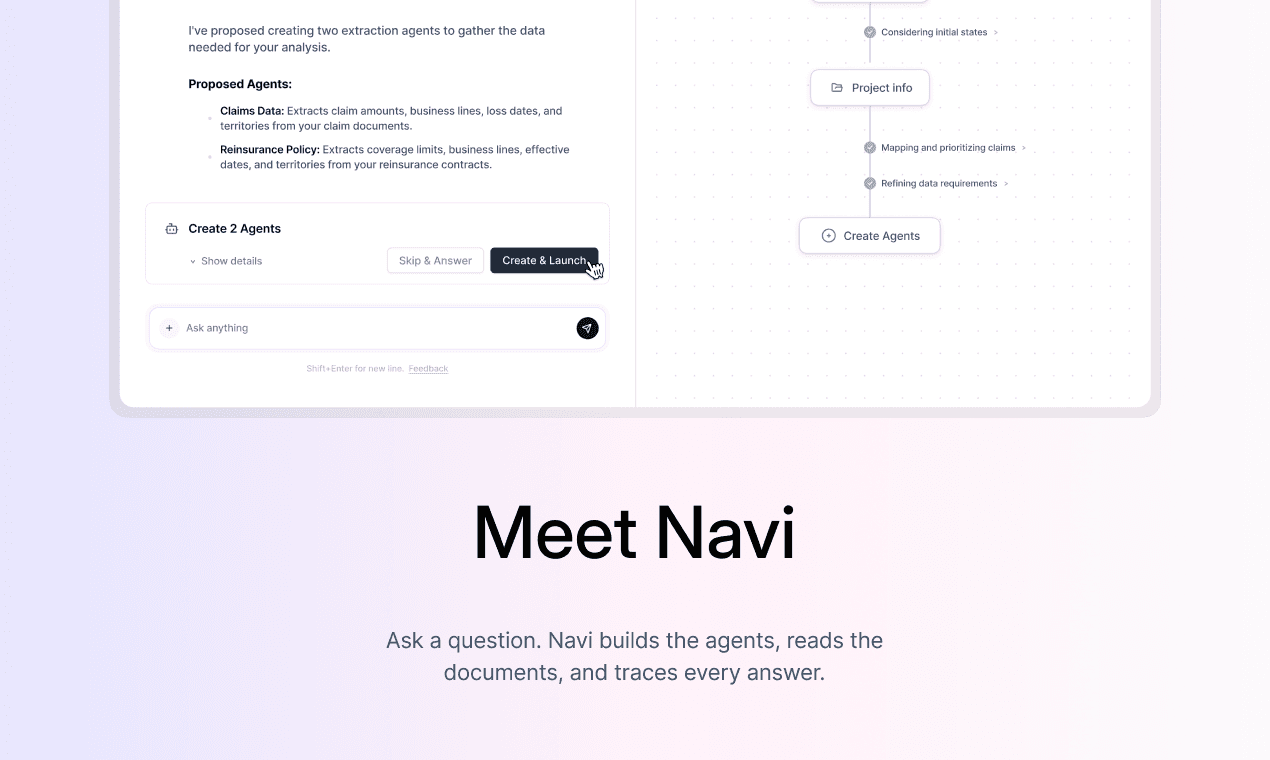
Navi is a guide to the Parsewise Data Engine. Instead of forcing users to learn the platform first, Navi helps them start with what they already know: the questions they want answered and the data they need from their documents.
Through a simple interface, users can describe what they want to analyse, explore what is possible, and progressively build powerful agents without needing to understand the underlying system. Over time, this changes how users interact with the platform. Instead of configuring workflows step by step, they orchestrate them.
In a way, users act as conductors: turning their questions into an orchestra of Parsewise agents, each specialised in a specific topic. Self-improving and easy to govern. Like your best team of human analysts, but virtual.
The value of Navi isn’t theoretical, but it’s real today. Here are a few examples of how customers are using Navi today.
Example 1: Insurance Claims Portfolio Triage (→ demo)
An insurance claims analyst is reviewing a portfolio of claims. The project contains hundreds of documents - loss summaries, incident reports, medical notes, and internal claim records.
The analyst needs to quickly identify which claims present the greatest financial or legal risk before those risks escalate or impact reserves.
Instead of manually reviewing each file, they upload the documents to Parsewise and ask Navi:
“Flag the three financially or legally riskiest open claims in this portfolio and summarise them in a table.”
Navi begins by analysing the documents and determining what information needs to be extracted. It proposes creating several agents to gather the relevant data:
- Claim Status: identifies whether a claim is open or closed
- Total Reserve Amount: extracts the financial exposure of each claim
- Litigation Status: flags claims involving legal proceedings
- Key Risk Indicators: summarises important risk indicators such as severe injuries or liability disputes
Once the agents are created and run across the documents, Navi analyses the extracted results and produces a structured table of the three riskiest open claims.
Within minutes, the analyst can see which claims require immediate attention, along with the underlying drivers of risk.
Instead of manually reading through hundreds of documents and potentially missing emerging severity signals, they can immediately focus on the exposures that matter most.
Example 2: Company Investment Diligence (→ demo)
A private markets analyst is preparing an investment memo for a Series-A startup her fund is evaluating.
Normally, this process takes days. More importantly, critical risks are often buried across pitch decks, financial models, and strategic documents, which often means inconsistent figures, missing data, and subtle contradictions that can easily be missed.
Instead of manually reviewing each document, she uploads them to Parsewise and asks Navi:
“Create an investment-ready company profile, highlighting key financials, market characteristics, competitors, and customer details.”
Navi analyses the documents and determines what information needs to be extracted. It proposes creating several specialised agents, including:
- Financial Performance Metrics: extracts KPIs such as ARR, revenue, gross margin, and cash burn
- Market Analysis: captures TAM, market growth rates, and key industry trends
- Competitive Landscape: identifies competitors and differentiating factors
- Customer Metrics: extracts unit economics such as CAC, LTV, and churn
Once the agents process the documents, Navi synthesises the results into a structured, investment-ready company profile.
In a very short time, the analyst has a clear view of the company, including highlighted inconsistencies and potential red flags across the documents.
What would normally take days of manual review and still risk missing critical issues is now completed in minutes with far greater confidence.
Example 3: Mortgage Underwriting Automation (→ demo)
A mortgage broker is reviewing an application from a couple applying for a home loan.
The application includes a large number of documents: payslips, bank statements, expenditure declarations, and deposit information - all submitted in different formats.
To assess the application, the broker needs a clear view of income, commitments, and deposit sources to identify any gaps and risks before making a lending decision.
Instead of reviewing each document manually, she uploads the files to Parsewise and asks Navi:
“Summarize the financial details for the mortgage application, including income, expenditures, and deposit sources.”
Navi analyses the documents and proposes creating several agents to extract the relevant information:
- Monthly Gross Income: extracts the applicants’ total monthly income from payslips
- Monthly Expenditures: identifies recurring costs such as rent, council tax, and subscriptions
- Deposit Amount: determines the total funds available for the mortgage deposit
Once the agents process the documents, Navi compiles a structured financial summary of the application.
In this case, the applicants have a combined monthly income of approximately £10,833, average monthly expenditures of around £2,484, and a £85,000 deposit sourced from personal savings and a family gift.
Instead of manually piecing together this information across multiple documents, the broker can review the applicant’s financial position in minutes.
In all of these examples, what makes Navi powerful isn’t just how easily the agents were created or how quickly the answers appeared. It’s the scale it operates at and the reliability of the results.
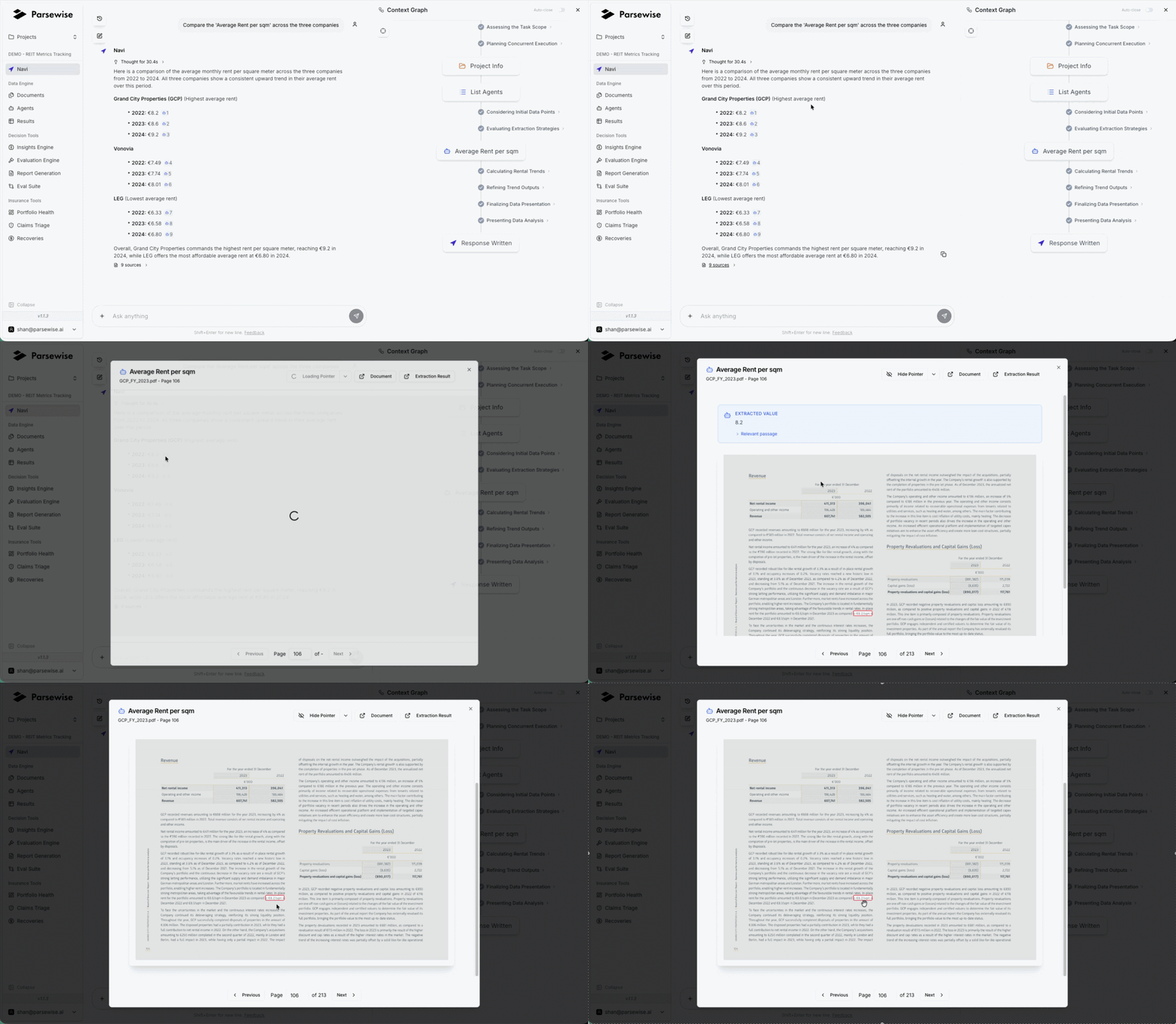
Behind the scenes, the Parsewise Data Engine processes every page of every document and returns structured outputs that are fully traceable back to the source material. Every figure, claim, and extracted insight is backed by citations that link directly to the original document.
This means users don’t just receive an answer - they can get proof of where it came from. What’s more: users can control how sources are combined to generate the answer by editing their agents.
Navi Under the Hood
Many AI agents today are thin layers on top of large language models. They can answer questions, but often struggle to produce reliable, repeatable outputs that become structured data assets for the organisation.
Navi agents are designed differently. They are vertically integrated, meaning each agent connects three layers of the system: the user’s intent, the reasoning required to interpret that intent, and the enterprise data needed to produce an answer.
When a user asks a question, such as identifying legal risks in a portfolio of insurance claims, Navi first translates that request into a structured set of tasks. These tasks are then handled by independent workers who focus on specific dimensions of the problem, such as claim status, financial exposure, or regulatory compliance.
Each Parsewise agent operates across the full stack of enterprise data. Instead of being limited to a single source, agents can extract information from PDFs, spreadsheets, emails, presentations, and other structured or unstructured inputs. The Parsewise Data Engine then processes these sources at scale, ensuring that the outputs are consistent, traceable, and grounded in the original documents.
This architecture allows Navi to move beyond simple question answering. Instead, it creates reliable workflows that can analyse large collections of documents and generate structured, repeatable outputs.
Ultimately, our goal is simple: to make working with proprietary data feel less like operating software and more like collaborating with a knowledgeable teammate.
Navi is our first step toward that future.
If you want to experience the future today, you can try now. If you want to help shape Navi, reach out to us!